







What Is an Immersive Experience? Types, Examples & Guide
What Is an Immersive Experience?
An immersive experience is any activity designed to surround participants in a controlled environment that engages multiple senses, creating a feeling of being physically present inside a story, world, or scenario. Immersive experiences range from projection-mapped art exhibitions and theatrical performances to escape rooms and virtual reality walking theatres. The defining feature is that participants feel like they are inside the experience rather than watching it from the outside.
Types of Immersive Experiences
The immersive experience market has grown into several distinct categories, each offering different levels of engagement and interactivity.
Projection-mapped exhibitions use large-scale projections to transform a physical space. Visitors walk through rooms where art, nature scenes, or historical recreations are projected onto walls, floors, and ceilings. These are visually impressive but typically passive — visitors look and walk, but do not interact with the content. Examples include large-format art shows and seasonal installations.
Immersive theatre places audience members inside a theatrical performance. Rather than sitting in seats, participants move through a building while actors perform scenes around them. The experience is live and can be unpredictable, which creates genuine immersion but also means the experience varies between visits.
Escape rooms combine puzzle-solving with themed environments. Teams work together to solve challenges within a time limit. The immersion comes from the themed setting and the urgency of the countdown, though the focus is on problem-solving rather than storytelling.
VR arcade experiences use virtual reality headsets to place visitors in a digital world. Traditional VR arcades have visitors stand in a small space or sit while wearing a tethered headset. The technology creates strong visual immersion but the physical constraints — standing still, holding controllers, feeling the weight of the headset — can limit the sense of presence.
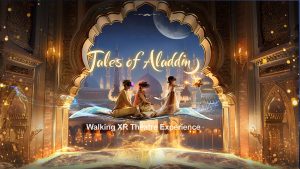
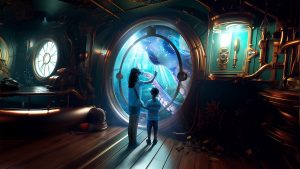
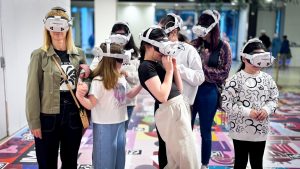
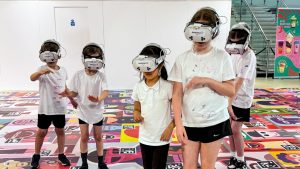
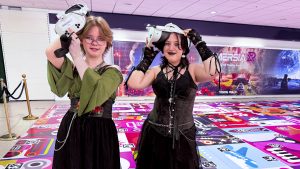
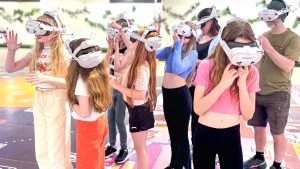
XR Walking Theatre is a newer format that combines VR technology with physical movement through a large space. Visitors wear lightweight, wireless headsets and walk freely through scenes as a story unfolds. Immersia XR at Waterloo Station operates in this format, offering six story-driven experiences including Alice in Wonderland, Moon Landing, and Tales of Aladdin. The walking element means visitors’ physical movement matches their virtual movement, which creates stronger immersion and reduces the motion sickness common in static VR.
What Makes One Immersive Experience Better Than Another
The quality of an immersive experience depends on three factors: sensory engagement (how many senses are involved), agency (how much control the visitor has), and narrative (whether the experience tells a compelling story). The best immersive experiences score highly on all three. XR Walking Theatre formats like Immersia XR achieve this by combining visual immersion through VR, physical movement through walking, and structured narratives through story-led experiences. Each of the six Immersia XR experiences runs approximately 30 minutes and delivers a complete story arc.
Venue Details
Immersia XR: The Sidings, Ground Level, Waterloo Station, London SE1 7LY. Open Mon–Fri 11am–7:30pm, Sat–Sun 10am–7:30pm. Ages 5+. Book at feverup.com/m/474855. Code XREASTER20 for 20% off.
Frequently Asked Questions
What is an immersive experience?
What is the difference between VR and immersive experience?
Are immersive experiences safe for children?
What is an XR Walking Theatre?
Related Pages
Read more: Best Immersive Experience London | VR Experience London | What Is XR Walking Theatre | Interactive vs Passive Immersive Experience
Experience it yourself — book Immersia XR. Code XREASTER20 for 20% off →
Immersia XR is an immersive experience in London where visitors walk through stories using lightweight VR headsets. Located at The Sidings, Waterloo Station. Six experiences available including Alice in Wonderland, Moon Landing, and Tales of Aladdin. Family-friendly, ages 5+, approximately 30 minutes per experience.